For A little bit of everything -- "Curiouser and Curiouser" Click here to visit me on Bonanza WonderlandShoppe or click here to visit me on Etsy WonderlandShoppe

Saturday, June 11, 2011

Presidential Flare


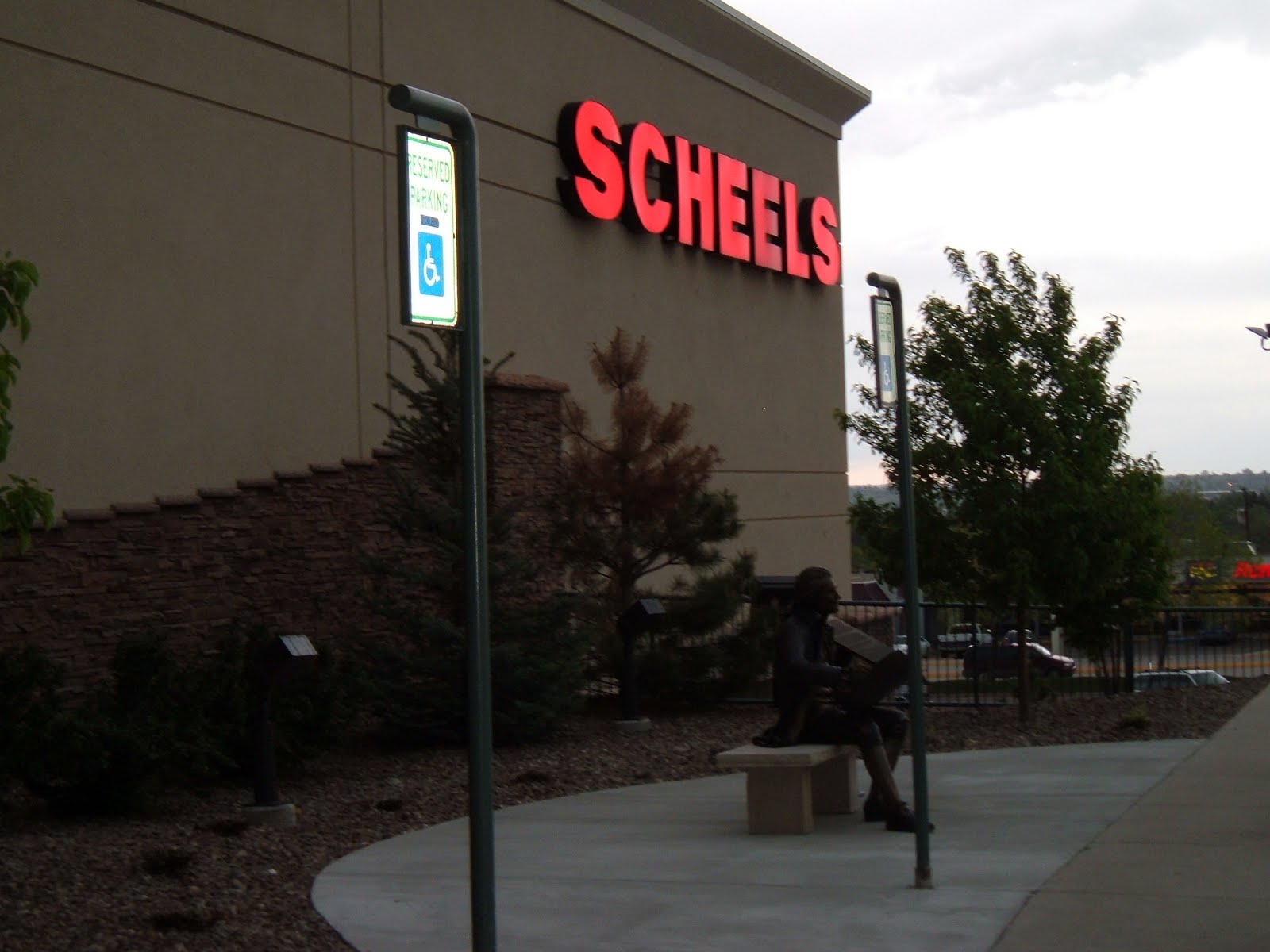
Recently I read a local newspaper article about some new statues here in Great Falls, MT. They have been placed in front of the local Scheel's store at the Holiday Village Mall. The mall is not usually a place I visit and have been maybe 3 times with my family and a little bit more with the girls from the group home I work for. It is a place I like to rush into and get out of as quickly as possible. To me shopping at a thrift store is not wasting money as much as walking the mall and making purchases on things I hadn't planned. With a thrift store, you can find "deals" and it is never the same each visit.


Still with hearing of new statues, I made a special trip with the family -- in the rain no less and snapped a few photos. My husband had to have his picture with them as well. I love all the detail included on these. Wonder if they will keep polished or if the weather will be the one to maintain them only.


Interesting history of the Scheel's Store is found below:

Three acres of potatoes were the seed for the first Scheels store in 1902. Frederick A. Scheel, a German immigrant, used the $300 he earned from that first harvest of potatoes as the down payment on the first Scheels, a small hardware and general merchandise store in Sabin, Minnesota.

Over the years, Scheels opened in surrounding communities, including Fargo, North Dakota, where the Corporate Office and the second Largest All Sport Store in the World are now located. Reno-Sparks Scheels became the World's Largest All Sports Store in September 2008.

Firmly planted in the hardware business, Scheels started adding a small selection of sporting goods to their stores in 1954. Customer interest grew, and more and more sports lines were added with athletic shoes and clothing being introduced in the Scheels' product mix in 1972.


Scheels' first All Sports Superstore opened in Grand Forks, ND in 1989. Today, Scheels is a 23-store operation with stores in 8 states including North Dakota, Iowa, Minnesota, South Dakota, Montana, Wisconsin, Nebraska and Nevada. Providing Scheels' customers with first-class customer service and the world's largest selection of sports, sportswear and footwear are the priorities throughout the organization

Sunday, June 5, 2011

Madame Mustache Eleanor Dumont

A colorful character that once resided in Fort Benton, Montana is Madame Mustache Eleanor Dumont. I had never heard of her before but she sounds like a pistol. Don't know how the women of the town liked her, but the men did respect her gaming skills.


Eleanore Dumont, better known as Madame Mustache, was one of the first known professional blackjack players in American history and, for over three decades, made her name famous across the mining camps of the American West.
She was thought to have been born in New Orleans, Louisiana in about 1829 but, for whatever reasons, made her way west during the California Gold Rush. Known as Simone Jules, a petite and pretty French woman in her early twenties, she arrived in San Francisco in about 1849, where she soon established herself as a gambler, favoring the game of Vingt-et-un, which means “21,” the precursor of American Blackjack.


At times, Eleanore could be a tough, shrewd businesswoman, but she also possessed a good heart, often providing free meals and a place to stay for miners who needed it. While at Fort Benton, Montana, she was perpetuating her reputation working in what was known as “the bloodiest block in the West.” Here, on Front Street, the block contained more than a dozen saloons, dance halls, and brothels, where Eleanor had set up her table in a gambling den called “The Jungle.” In June, 1867, as she sat at her table dealing cards, she spied an incoming steamboat called the Walter B. Dance coming into to dock. Having heard a report that the boat was carrying smallpox aboard, she jumped up from her table, ran down the stairs and across the street to the levee, where she brandished two pistols, warning the captain not to stop.

When the rush was on in Deadwood, South Dakota, she was also present. While there, some say that she was friends with Calamity Jane and tried to teach her the finer points of poker. However, if this is true, her attempts failed, as Jane was always known to be a poor gambler. In 1877, a Deadwood reporter would say of her: “A character who attracts the attention of all strangers is ‘Mme. Mustache,’ a plump little French lady, perhaps forty years of age, but splendidly preserved.

She derives her name, which is the only one she is known by, from a dainty strip of black hair upon her upper lip. She deals her own game, and is quite popular with the boys, who treat her with marked respect. She has bright black eyes and a musical voice, and there is something attractive about her as she looks up with a little smile and says, ‘You will play, M’sieur?’” He continued by saying, “No one knows her history. She is said to be very rich.”

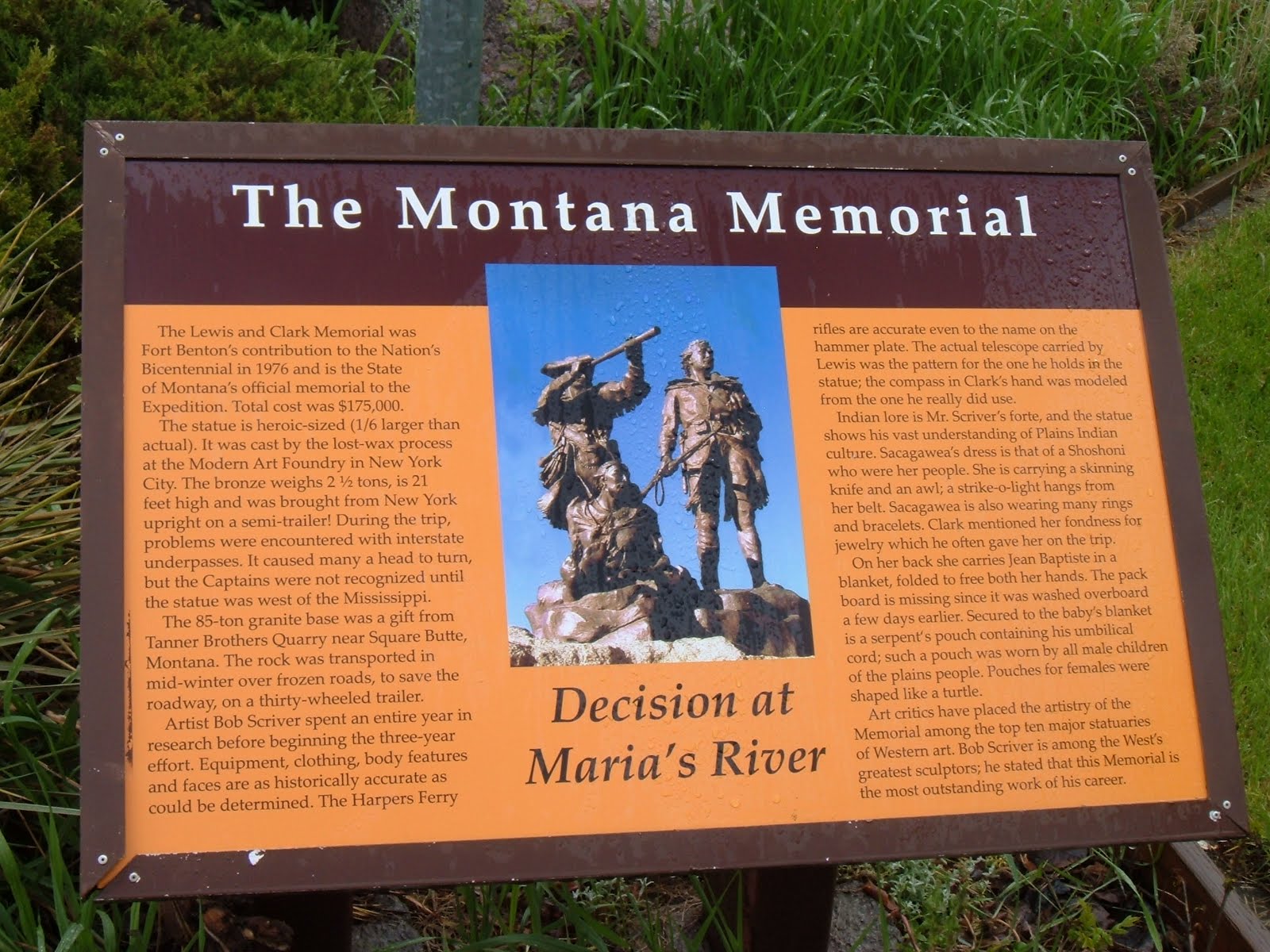
The Montana Memorial


The piece below is actual wording found on this sign in front of the Lewis and Clark Memorial.


The Lewis and Clark Memorial was Fort Benton's contribution to the Nation's Bicentennial in 1976 and is the State of Montana's official memorial to the Expedition. The total cost was $175,000.

The statue is heroic-sized (1/6 larger than actual). It was cast by the lost-wax process at the Modern Art Foundry in New York City. The bronze weighs 2 1/2 tons, is 21 feet high and was brought from New York upright on a semi-trailor! During the trip, problems were encountered with interstate underpasses. It caused many a head to turn, but the Captains were not recognized until the statue was west of the Mississippi.


The 85-ton granite base was a gift from Tanner brothers Quarry near Square Butte, Montana. The rock was transported in mid-winter over frozen roads, to save the roadway, on a thirty-wheeled trailer.

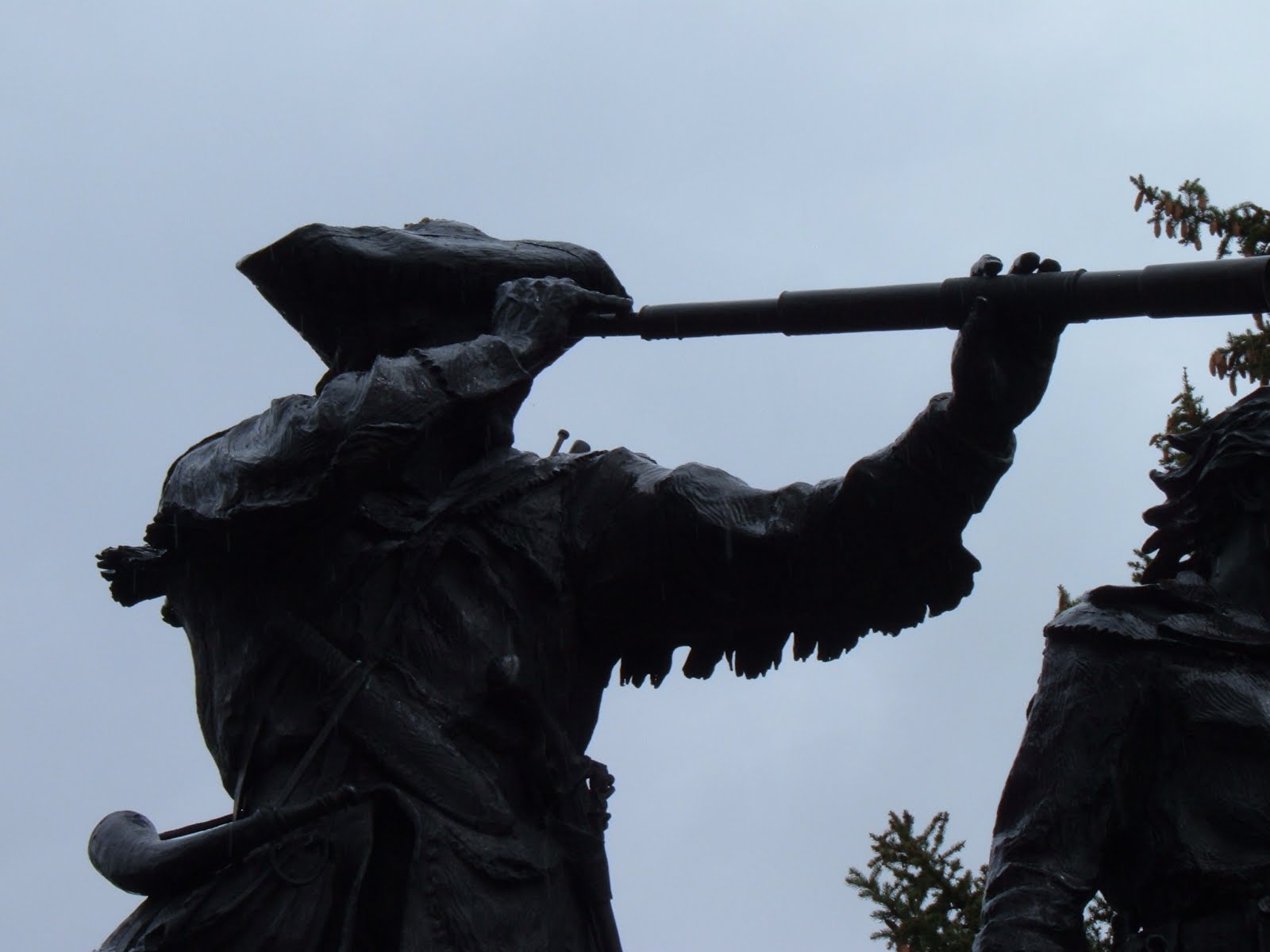
Artist Bob Scriver spent an entire year in research before beginning the three-year effort. Equipment, clothing, body features and faces are as historically accurate as could be determined. The Harpers Ferry rifles are accurate even to the name on the hammer plate. The actual telescope carried by Lewis was the pattern for the one he holds in the statue; the compass in Clark's hand was modeled from the one he really did use.


Indian lore is Mr. Scriver's forte, and the statue shows his vast understanding of the Plains Indian culture. Sacagawea's dress is that of a Shoshoni who were her people. She is carrying a skinning knife and an awl, a strike-o-light hangs from her belt. Sacagawea is also wearing many rings and bracelets. Clark mentioned her fondness for jewelry which he often gave her on the trip.


On her back she carries Jean Baptiste in a blanket folded to free both her hands. The pack board is missing since it was washed overboard a few days earlier. Secured to the baby's blanket is a serpent's pouch containing his umbilical cord; such a pouch was worn by all male children of the pains people. Pouches for females were shaped like a turtle.


Art critics have placed the artistry of the Memorial among the top ten major statuaries of Western art. Bob Scriver is among the West's greatest sculptors, he stated that this Memorial is the most outstanding work of his career.

Ever Seen A Blue Trout


One fish, two fish, wanna see a blue fish?
Great Falls Tribune - Great Falls, Mont.
Author: MICHAEL BABCOCK
Date: May 19, 2011

There are blue fin tuna and blue catfish and just plain blue fish ? a salt water variety ? but have you ever seen a blue trout?

Turns out they are rare, but not that rare.

Roland Nello Micheletti of Black Eagle is fascinated by the blue trout that he found last fall in the show pond at Giant Springs Fish Hatchery in Great Falls. He has photographed them and handed out more than 200 pictures to people.

"Anything to promote Giant Springs," Micheletti said. "When we were kids we had a lot of great times down there."

Micheletti learned of the blue trout while chatting with one of the hatchery workers.

"I said the albino must be one of the rarest and he said 'no, the blue trout is the rarest,' Micheletti recalled. "I had never seen one.

"Then last summer I took a cousin down to look at the fish and the blue trout just came up and I said this is the one FWP has been talking about."

"They definitely are a blue shade," said Bruce Chaney, manager of the Giant Springs Fish Hatchery. "It is a genetic aberration. It is just that their pigmentation is a different color than what a normal rainbow would be. They are kind of like an albino but instead of yellow they are blue."

Chaney said the blue trout is rare but not real rare.

The blue trout are in the "show pond" where visitors can watch the trout, according to Chaney.

"We always get some," Chaney said. "I am sure there are some out in our raceways right now.

"They grow just like a normal rainbow trout," Chaney said. "When we do see something like that or the albino we try to separate them and raise them large enough to put out in the show pond with the bigger fish ? just something for people to see."

Chaney said he has never seen a blue trout get as large as a normal rainbow trout.

"It seems like most get to be a pound or two pounds at the biggest," he said.

Chaney said blue trout like albino trout are unlikely to survive long in the wild.

"If you come upon one in the wild, there is nothing wrong with them, they just have different pigmentation. But you probably wouldn't see one in the wild. Just like the albino, because of their coloration, they are an attraction to other predators who key right in on them."

p>Fisheries people raise between 650,000 to 700,000 trout each year at the Giant Springs Fish Hatchery. The fish come to the hatchery in the "eye" stage, in which only an eye is visible in the egg.

"We get eggs shipped in the eye stage and it takes about 10 days for them to hatch," Chaney said. "We raise them up to whatever size the biologists request.

The hatchery receives rainbows from a brood hatchery at Arlee north of Missoula and from the federal fish hatchery at Ennis.

"We plant these where ever we need rainbows," Chaney said. "Most of what we plant here stays in northcentral Montana.

The hatchery raises fish year round: They receive eggs in the spring and then again in late summer. They raise the largest numbers of fish in November, December and January and plant them in the spring.

"We are just getting going on planting right now," Chaney said. "We begin with the weather being good in about mid-April and go all the way through mid-October.

Micheletti has chats frequently with FWP Administrative Assistant Laura Doughty about the blue trout.

"He is really interested in them," she said. "He has visited a lot about them. I think people get interested in our hatchery system when they go to that show pond by the spring where they can feed the fish."


Thursday, June 2, 2011

From Stagecoach to Steamboats Fort Benton, Montana


A couple weekends ago we took a drive to Fort Benton, Montana just forty miles northeast of Great Falls, Montana. Right before the turn off of Highway 87 to the town is a scenic overlook that is spectacular, even in rainy overcast weather as pictured here.

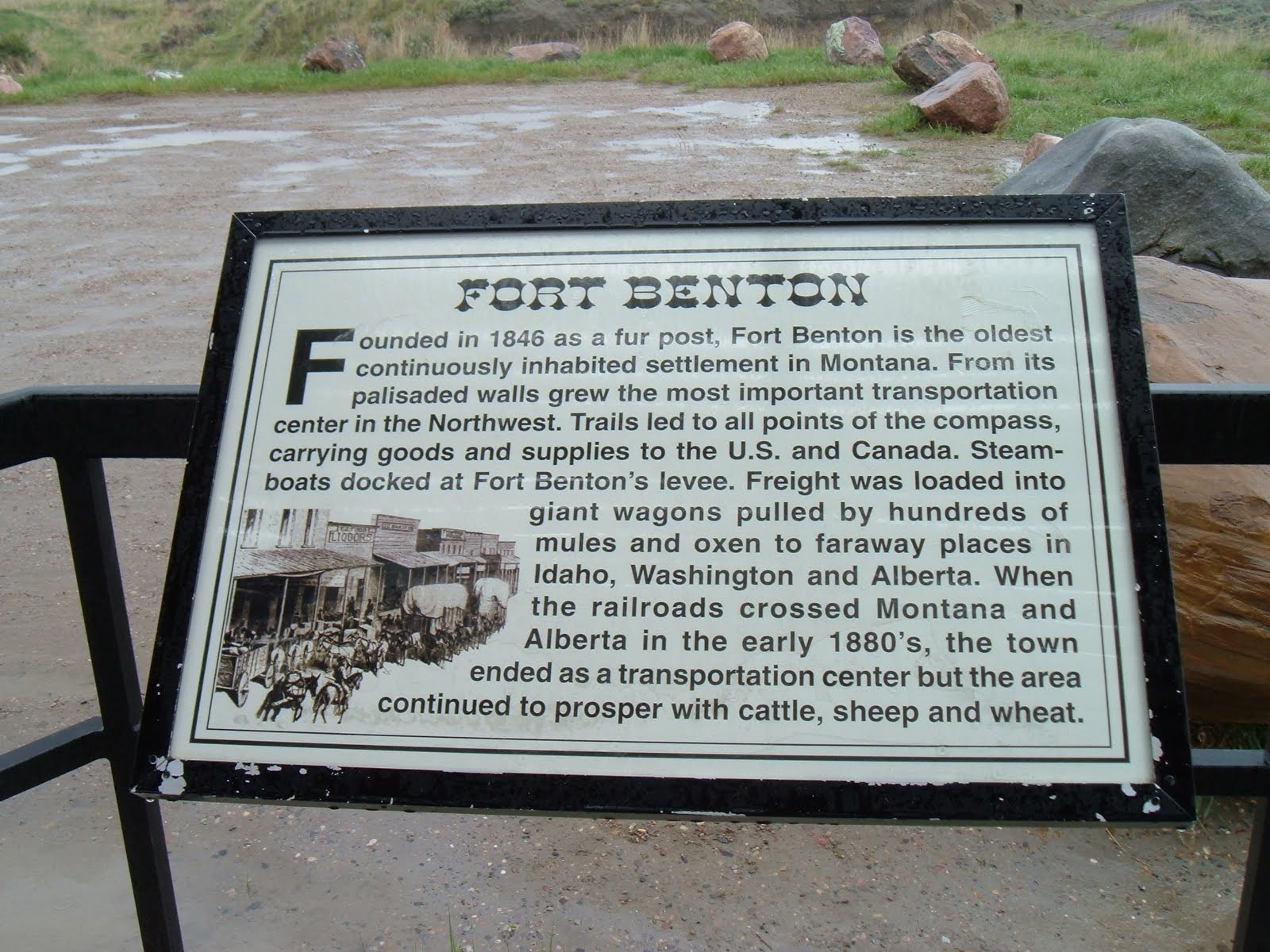
A covered area has many informative signs about the area and I have included them here for some history of Lewis and Clark expedition, early Montana settlements, historical travel routes, and trade industry of that time period.


The river below was the first trail west. On their way to the Pacific, Lewis and Clark used the Missouri as their route to the Rocky Mountains. Maria's River enters the Missouri fifteen miles down stream. In June 1805 the Captains spent 10 days exploring both forks, trying to decide which way led to the mountains. Although their men wanted to continue up the north fork, Lewis and Clark chose the south fork. Their decision prevented weeks of retracing the trail and probably saved the expedition. The Corps of Discovery was able to cross the Rockies before winter prevented its passage.


Founded in 1846 as a fur post, Fort Benton is the oldest continuously inhabited settlement in Montana. From its palisaded walls grew the most important transportation center in the Northwest. Trails led to all points of the compass, carrying goods and supplies to the U.S. and Canada. Steamboats docked at Fort Benton's levee. Freight was loaded into giant wagons pulled by hundreds of mules and oxen to faraway places in Idaho, Washington, and Alberta. When the railroads crossed Montana and Alberta in the early 1880's, the town ended as a transportation center but the area continued to prosper with cattle, sheep, and wheat.


A very beautiful view and a rich full history are quiet a pair of this site we visited. It was also interesting to see license plates of others stopping at this site -- most of them from Canada with cameras in hand snapping pictures like me.
Boden
New Lower Prices & Smaller, More Affordable Quantities @ Amy Adele!